Your EAP can't prevent burnout. Here's what can.

Most organisations that take employee wellbeing seriously have an Employee Assistance Program, or EAP; orgs above a threshold size are required to have one. They budget for it, communicate about it, and encourage people to use it. EAPs are necessary, but they can't do everything. If burnout rates in your team aren't improving, the EAP isn't the problem. It's just not designed to do the job you need done.
Understanding where EAPs fall short, what prevention actually requires, and how to square that with performance, is the clearest way through a problem that can feel genuinely unsolvable for many leaders.
The tool most organisations already have
Employee Assistance Programs are counselling and support services, typically provided by a third-party provider and funded by the employer. In Australia, organisations above certain size thresholds are required to have them. They're well-intentioned and professionally delivered, if not very widely used.
They are also, by necessity, reactive. Someone has to be struggling before they pick up the phone. The EAP responds to distress, it doesn't prevent it.
Where EAPs sit in the hierarchy
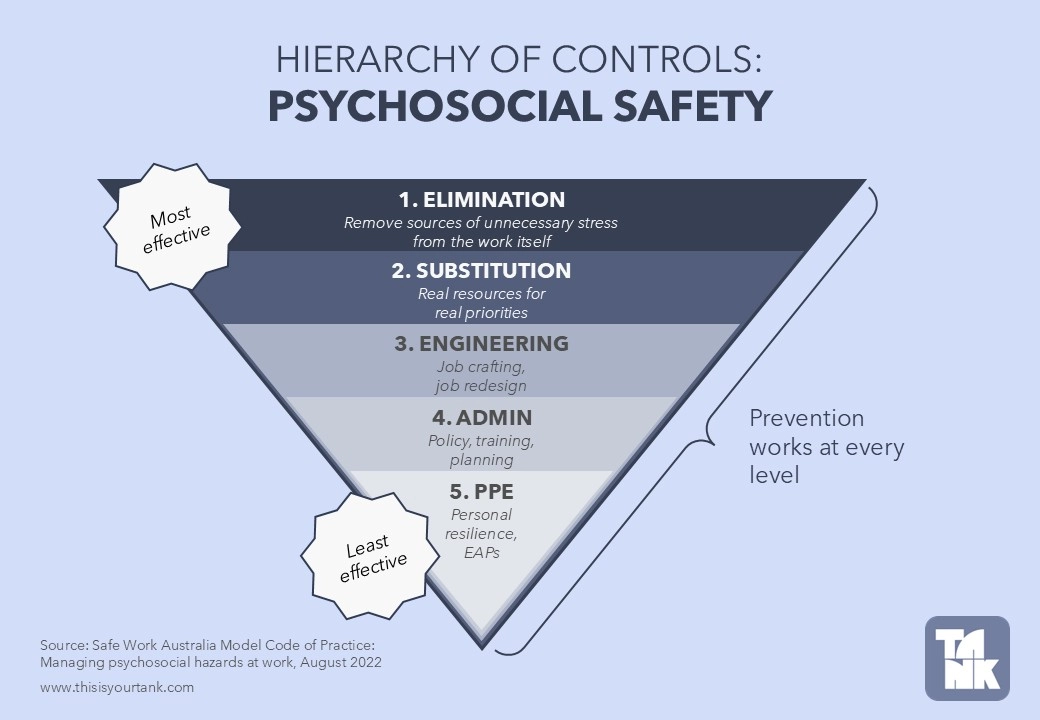
Safe Work Australia's Code of Practice on Managing Psychosocial Hazards at Work uses the same hierarchy of controls that applies to physical safety. At the top: eliminate the hazard. At the bottom: personal protective equipment. PPE and EAPs are the last resort, used only when nothing else is practicable.
No safety-conscious organisation would design its physical safety program around PPE alone. The same logic applies to your EAP.
More first aid than prevention
We'd argue that "PPE equivalent" understates the problem. PPE is at least designed to protect you before harm occurs. EAPs, by contrast, are available only after something has gone wrong. In that sense, they're closer to first aid than to a hard hat.
First aid matters. You want it to be available. But it's not a substitute for designing the work environment so that serious injuries are less likely to happen in the first place.
Chronically invisible
Physical safety has a long history of managing acute injury: the fall, the crush, the cut. Organisations have mature systems for preventing and responding to these. The injury occurs in a single event, is visible, the cause is immediately identifiable, and the response is clear.
Chronic injury is harder. Even in the physical safety space, cumulative strain conditions, occupational disease, and long-term exposure hazards are still a significant blind spot despite decades of attention. In the psychosocial space, we're much further behind.
Most of the regulatory and cultural attention in psychosocial safety has landed on egregious behaviour: bullying, harassment, discrimination. These are important, and often they're easier to define and identify. By contrast, chronic stress, the kind that accumulates under sustained time pressure, role conflict, and insufficient recovery, is more diffuse, more deniable, and far more common.
The relationship between chronic and acute isn't linear, either. A team leader operating under sustained pressure is physiologically depleted. Depleted leaders have less capacity for patience, clarity, and the kind of careful explanation that prevents misunderstanding. They're more likely to snap, less likely to resolve conflict well. The same chronic stress that goes unnoticed in the background increases the probability of the acute incidents that do get noticed — and reported.
This means that addressing chronic stress isn't just prevention for its own sake. It's upstream of a significant proportion of the acute psychosocial harm that organisations are already trying to manage.
What the law now requires, and why it might feel impossible
Australian psychosocial safety legislation, progressively adopted across states and territories based on Safe Work Australia's model code of practice, now requires organisations and their leaders to manage psychosocial risks proactively. The first line of control is elimination: remove the source of the hazard.
For many leaders across line, HR, and WHS roles, this is where it can start to feel impossible. Remove unreasonable deadlines? Eliminate conflicting demands? Those decisions don't sit with any individual leader or department. They're driven by business objectives, client demands, market shifts. And as technological disruption accelerates, everyone is being asked to go faster.
That tension is real. Acknowledging it is the starting point for finding an approach that actually works within those real constraints.
The hierarchy of controls doesn't require perfection at the top before you're permitted to act further down. It asks you to start as high as you can, and layer controls from there. But the key to making those controls coherent throughout the hierarchy is the same thing: an early, open, transparent handle on unnecessary stress and its root causes. What's generating chronic pressure? Where is recovery being systematically squeezed out? Those questions need to be visible before they can be addressed, throughout the levels of the hierarchy.
What prevention actually looks like
The shift from reactive to preventive isn't a single intervention. It's a change in how you think about the problem, in who's responsible for solving it, and in the capabilities and infrastructure you build across the organisation.
For individuals: Prevention means understanding and taking responsibility for your own stress-recovery balance, including building the capacity to read your own balance signals accurately, and acting on them before depletion becomes a crisis. This is the individual level of TANK's Fuel-Gauge-Terrain framework: track your own Fuel and Gauge, ask for the help you need to shift the Terrain.
For team leaders: Prevention means understanding that burnout is a system design problem, not a personal failing. The Terrain your team operates in, including their workload, level of autonomy, role clarity, and available recovery time, can make sustainable performance the default setting, or next to impossible. Leaders who diagnose and redesign that terrain are doing prevention work. This starts with visibility: understanding where chronic pressure is accumulating in the team before it becomes acute. Importantly, leaders who can do this well are also less likely to become a psychosocial hazard themselves.
For organisations: Prevention means treating psychosocial risk the same way you treat physical risk — systematically, with controls applied at the highest practicable level. In practice, that means two things working together: First, give team leaders the skills they need to work with their teams to make good stress-recovery balance easier to achieve. Support them to identify and eliminate drivers of unnecessary stress, and to build work rhythms that include regular recovery by default, not as an afterthought. And second, back them up with the tools and resources they need to manage complex conversations and track ongoing change.
How TANK can help
The Fuel-Gauge-Terrain framework is TANK's evidence-based model for burnout prevention: Fuel is the balance between stress and recovery; Gauge is your ability to read your own signals accurately; Terrain is the system environment that makes balance easier or harder.
TANK's approach, including our workshop and leadership program, are designed to support consistent diagnosis and intervention throughout the hierarchy, from guiding teams to collaborate effectively on eliminating low-value work, through to building individual skills in self-regulation and resilience.
The approach enables leaders to act quickly and meaningfully, with the team they have, inside the constraints they're working with.
If you're wondering why burnout rates aren't improving, the answer probably isn't a better EAP. It's all the levels of the hierarchy above it.
Talk to us about what better psychosocial safety could look like for your team.