A Product Manager's Experience with Burnout
When the Numbers Are Great and You're Falling Apart: A Product Manager's Experience with Burnout
Oliver is a product manager based in Melbourne. We sat down with him to talk about how burnout crept up on him during one of the most exciting chapters of his career, and the deliberate choices he's made since then to protect his wellbeing.
Burnout seems especially cruel when it arrives in the middle of something great.
For Oliver, it arrived on a Tuesday afternoon in Palermo, Sicily. He was six weeks into a remote working stint in one of Europe's most beautiful old towns. He and his partner had a top-floor apartment in the historic quarter, morning walks to get coffee, cobblestoned streets to wander. He was working as a product manager at a fast-growing, VC-backed tech startup, a team he genuinely loved, with numbers moving in the right direction, clear momentum, real impact.
He hung up a call around 5pm and burst into tears.
"At the time it kind of came out of nowhere. I was living in a beautiful city, working a job I loved, with a team I rated highly. On the one hand I felt like I should have been thriving. But it suddenly caught up with me”
The Myth of the 60-Hour Week
Like many people, Oliver had a specific idea of what burnout looked like. He assumed it was something that happened to people running on fumes, doing 60 or 70-hour weeks, an engine literally burning out. He wasn't that person. He was working 9 to 7, maybe 9 to 8 on a tough day. By most measures, he was doing fine.
But the culture around him blurred lines he didn't realise he was crossing. He worked alongside colleagues who came from high-intensity finance backgrounds, who thought nothing of dropping Slack messages at midnight or leaving comments on a deck at 10:30pm. Oliver didn’t think he was matching those hours, but they crept up in subtle ways anyway.
"I had Slack on my phone. Even when I stopped at 7pm, I would still check. The nature of the work meant I was tracking numbers constantly: are we getting more customers, what's the revenue? I wanted my numbers going up all the time. I got a little too attached to it."
What he didn't account for (and what almost none of us account for) is that product management is emotionally demanding in ways that are hard to quantify. Managing stakeholders, making judgment calls without clear right answers, carrying the weight of user outcomes: this is creative, relational, high-stakes work. Comparing it to hours on a spreadsheet is a category error. But it's a category error that's easy to make when everyone around you is visibly grinding.
“I thought that the pace, the context switching, the mental and emotional loads were all requirements of the role. It took me a while to realise the baseline had shifted and I had not quite adjusted.”
What Actually Helped
When the moment came, Oliver didn't dramatically quit or take a month off. He did something arguably harder: he kept going, more slowly and more honestly.
He had a frank conversation with his manager (one of the best he's had) and said plainly that the past few weeks had been too much. His manager sprang into action, reducing scope, providing support. The relief was immediate.
He was already seeing a therapist, and their sessions became more focused. One image stuck with him: an aeroplane gaining altitude too steeply. If the angle is too sharp, the thrust can't sustain it. Eventually, you stall. He'd been climbing at a stall-grade angle for eighteen months and hadn't noticed.
“It wasn’t just about working fewer hours. I needed to be more deliberate with stopping so I could actually feel recharged.”
He describes the months that followed as a deliberate unwinding, letting himself enjoy the remaining weeks in Palermo, getting genuinely excited about the move to Australia ahead, and beginning to build practices that would carry him forward.
The Factory Reset
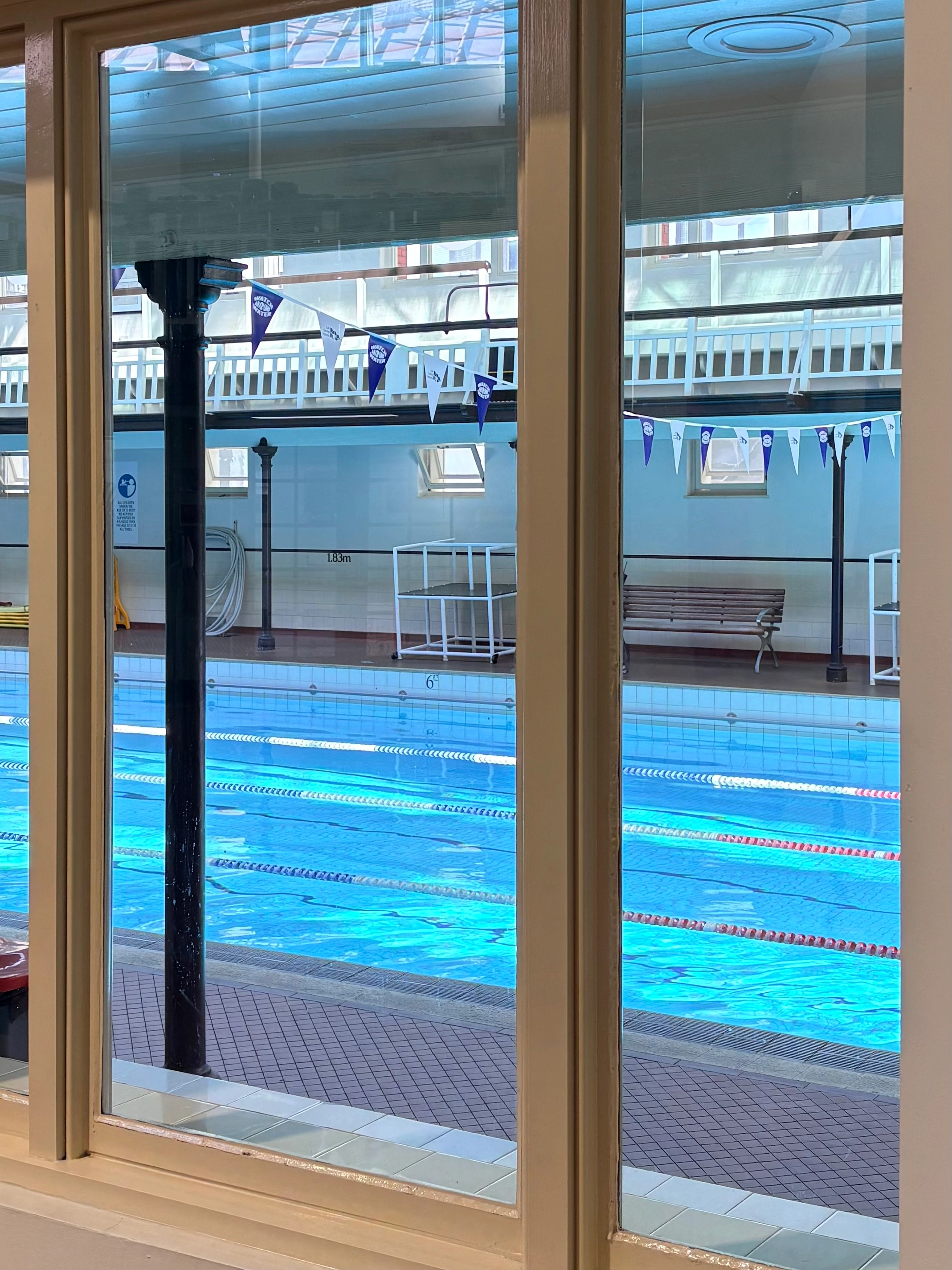
These days, Oliver's most consistent anchor is a Monday morning swim at a Victorian-era pool in Melbourne. It opens early, the water is quiet, stained glass casts light across the pool floor. He follows it with a sauna. He does it every week he can.
"It's like a factory reset," he says. "I feel stress physically: tight chest, different breathing. The pool and sauna change that. I come out feeling like a different person."
He came to swimming late, via cycling, a passion he inherited from his mother, who used long country rides as her own form of mental reset. Both share a quality Oliver has come to value: they demand just enough attention that you can't think about anything else. You are forced into your body and into the present moment.
He also thinks in categories. Mental. Physical. Social. Creative. He keeps a loose awareness of whether he's done something in each area, not as a rigid system, but as a gentle prompt to seek joy and rest in its various forms, rather than defaulting to nothing.
"It's a reminder that rest isn't one thing. Sometimes it's movement. Sometimes it's a connection. Sometimes it's making something."
Applying Product Thinking to Yourself
Oliver is candid that he still doesn't have it figured out. But he's developed a set of instincts that help him catch the early signals before they compound.
“I’ll notice small things - being a bit less patient than usual, or caring a bit too much about whether something I contributed to landed well. On their own they might not be much. But if I see a bit of a pattern across a few days that’s my cue to step back.”
This is, he points out, essentially a product skill applied to himself. PMs are trained to spot signals and patterns, to understand what users actually need versus what they say they need, to map the system rather than just react to individual events. He thinks the profession is unusually well-positioned to manage burnout, and unusually prone to it.
"I’ve heard that product managers and designers are particularly predisposed to burnout. Designers because their work is constantly critiqued - getting something that is user-friendly, that the PM is happy with, that developers aren’t anxious about, that the stakeholder wants - it’s a lot! PMs because we're conscientious: we care, and caring without appropriate boundaries is a fast path to exhaustion. But we're also analytical. We can practice introspection. We can treat our own minds and bodies the way we'd treat our users."
He's wary, too, of the trap of busyness for its own sake, a full calendar that feels productive but isn't. He's a believer in the idea that two hours of deep, focused thinking can be worth more than a full day of reactive meetings. The challenge is that this logic can be hard to live by in environments that equate presenteeism with contribution.
The Ongoing Work
What Oliver wants other product managers to know is simple, but not easy: it's not set and forget.
Burnout doesn't announce itself. It accumulates in the gap between the pace you're running and the pace your system can actually sustain. When everything is exciting and the team is good and the numbers are moving, the warning signs are easy to dismiss. That's precisely when they most need attention.
"I'll notice when my tone is off and tell myself to take a deep breath and let it go," he says. "I'm not saying I've nailed it. It's still a work in progress. But I'm paying attention. That's the difference."
The pool is always there on Monday morning, water clear, light streaming through the stained glass. Reset complete.
TANK helps individuals and teams break the tension between high performance and sustainable wellbeing, so everyone can do their best work without burning out. To work with us please get in touch. We'd love to hear from you.